
Creator research · 6 min read
I Let an Outlier Tool Pick My Next Investing Video
By PimpMyViews Team ·
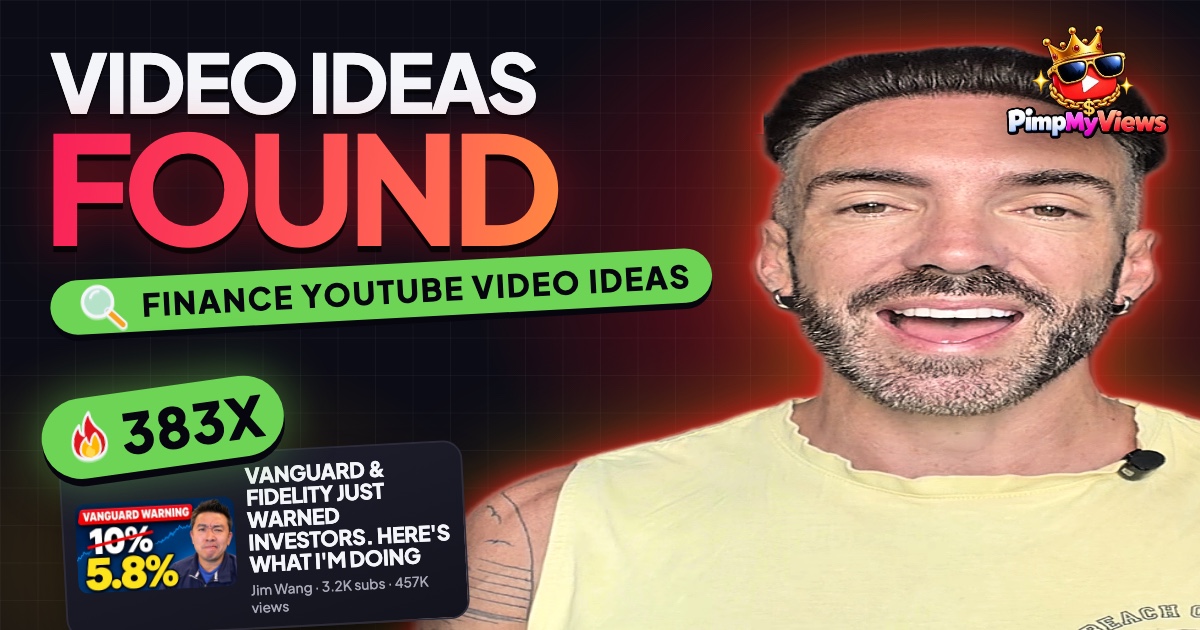
This video got 457,000 views. On a channel with 3,200 subscribers. His normal video gets about 1,200.
And it's about investing, which is exactly what I needed. I've got a second channel, PimpMyWealth, all about money and investing, and I needed my next video. So instead of guessing, I let the outlier tool on PimpMyViews pick the topic.
Here's exactly what came up, step by step, and how you can find finance YouTube video ideas (or ideas in any niche) the same way.
The problem with picking a topic in a money niche
Every day there's a new headline. Rates, gold, crypto, the AI boom.
If you chase the news, your video is old in a week. If you guess, you might spend ten hours on something nobody wants.
What I want is a topic people are watching right now, that they'll still be searching for next year. So here's the plan:
- Search.
- Spot the pattern.
- Ask why it worked.
- Read what viewers are asking.
- Choose.
Step 1: the search
The keyword was just one word: investing. Published in the last 30 days, so it's fresh. And long-form only, because that's what I make on PimpMyWealth.
Use the words your viewers would type, not the clever words you'd use. "Investing" beats "asset allocation optimisation" every time.
It found 21 videos, ranked by how far each one beat its own channel's normal views. Not by views. By how far it beat normal. That's the whole trick. If you're new to it, start with the outlier method.
Step 2: spot the pattern
Number one scored over 7,000 times its median. Sounds amazing. But look at the median: 74 views. When a channel's normal is that small, a giant score can come from almost anything, even paid ads. I can't explain it, so I skip it.
Number two was a business idea video in Hindi. Huge, but a different audience from mine, so I skipped that too.
Number three was the one from the start: "Vanguard & Fidelity Just Warned Investors. Here's What I'm Doing" by Jim Wang. 3,200 subscribers, 457,000 views, 383 times his median.
Then further down, there was another one: "Vanguard's New Data is a Reality Check for Investors" from Damien Talks Money. A much bigger channel, 432,000 subscribers. 1.6 million views, and 5.7 times his median.
Two different channels, a small one and a big one, both blowing up on the same story.
- One outlier can be luck.
- Two on the same topic is a pattern.
- And a pattern means viewers want it.
Step 3: ask why it worked
Every result has a Why it worked button. It compares the video with that channel's own usual videos. The deep dive put Jim's video at 420.6 times their median. That's a bit different from the list, because the deep dive works out the channel's usual views its own way. Either way, it's huge.
The AI explanation found three things:
- Big-name authority plus a warning. Vanguard and Fidelity are huge, trusted names, and millions of people have money with them. So the topic felt personal to people who'd never seen that channel before.
- A crossed-out number. The thumbnail shows 10%, crossed out, and 5.8% below it in big yellow. You get the whole story in one glance: your expected returns just got cut.
- It reached new, casual viewers. Likes per thousand views dropped from about 19 to 5. That sounds bad, but it isn't. It means lots of people outside his regular audience watched.
And here's the bit I love: the tool says the upload rhythm, the length and the title style were all normal. So the topic and the packaging made the difference. (The full method is in how to reverse-engineer any outlier.)
Step 4: read what viewers are asking
This is the part most people skip, and it's where your video idea is hiding.
In the same panel there's a Viewer questions tab. It reads the comments under the outlier and groups the questions people keep asking. Here's what it found:
- From 17 viewers, with 352 likes: "Haven't Vanguard and Fidelity been predicting low returns for years, and how accurate have their forecasts actually been?"
- From 8 viewers: "What return should I actually assume in my retirement plan: 5%, 6% or 10%?"
- And: "If stocks only return about 5.8%, should I move money into bonds or something safer?"
Every one of them is marked not covered yet. Thousands of people watched that video, and nobody has answered their questions. That's a gap.
Under each question, the tool even suggests a video idea. Under the retirement question: "What Return Should You Plug Into Your Retirement Calculator?"
Step 5: choose
Now I've got a short list, and I run every idea through four quick questions:
- Will it still matter in a year? The Vanguard news will fade in a few weeks. But "what return should I plan on" is a question people will ask forever.
- Have I already made it? I've already done a PimpMyWealth video on whether the AI boom is a bubble, so the AI story in that list isn't new for me.
- Does it fit my viewers? My viewers live all over the world, so I want an idea that works anywhere. What return to plan on works anywhere.
- Can I add something the others didn't? Yes. PimpMyWealth has free calculators, so I can run the same plan at 5, 6, 8 and 10% and show how much the answer changes.
So that's my pick. My next PimpMyWealth video is: What Return Should You Actually Plan On? 5, 6 or 10%.
Before I write a word of it, I check the facts myself. Vanguard's outlook from December 2025 put U.S. stocks at around 4–5% a year for the next decade, and Fidelity's 20-year assumption was about 5.8%. Those are forecasts, not promises, and that's exactly what the video will explain.
Borrow, don't copy
I'm not remaking Jim's video. I'm taking the topic his viewers proved they want, and answering the question they asked that nobody answered.
And I'll borrow one packaging idea, because the tool spelled it out: a crossed-out old number next to the new one. Ten per cent, crossed out, and a question mark. That's a pattern, not a copy.
Do it on your channel
- Search one simple keyword in your niche, from the last 30 days.
- Skip the scores you can't explain.
- Look for two or more channels blowing up on the same topic.
- Open Why it worked, and write down the topic and the packaging.
- Read the viewer questions, and find the one that's not covered yet.
- Then ask: will it still matter in a year, have I made it, does it fit my viewers, and what can I add?
It works for cooking, fitness, gaming, travel, anything. You can do it by hand by checking channels one by one. The outlier tool just does it in a few minutes.
Your homework: do one search in your niche, and tell me in the comments the best outlier you found, and the question its viewers keep asking.
Frequently asked questions
How do I find finance YouTube video ideas?
Search one simple keyword like "investing" for videos from the last 30 days, sorted by outlier score (how far each video beat its own channel's normal views). Look for two or more channels blowing up on the same topic, check why it worked, then read the viewer questions nobody has answered yet.
What is an outlier video on YouTube?
A video that got far more views than its channel normally gets. A video scoring 383x got 383 times the channel's median views, which tells you the topic and packaging reached far beyond the usual audience.
Why skip outliers from tiny channels?
When a channel's normal is only a few dozen views, a huge score can come from almost anything, even paid ads. If you can't explain why it worked, it's not a safe pattern to learn from.
Isn't making a video on the same topic just copying?
Not if you borrow the topic and answer a new question. Don't remake the video: take the topic viewers proved they want, and answer the question in the comments that nobody has covered yet.
Get The Outlier Report
Each week, the biggest breakout videos across popular niches — straight to your inbox. Free.